
Liz Sargent Says “Not Having Answers is an Adoptee Experience”
Mixed Asian Media - November 20, 2026
By Hayley Lee Palmer
Powered by JoySauce
For Liz Sargent, the journey to filmmaking began with her family. Sargent, herself a Korean adoptee, is the middle of 11 siblings— a mix of biological and adopted children, several with disabilities — and spent her 20s grappling with her inevitable future role in their care. These experiences with adoption, disability and caregiving would eventually shaped her first feature film.
Take Me Home stars her youngest sister, Anna Sargent, in her first feature role as Anna, a middle-aged Korean adoptee with a cognitive disability who cares for her aging parents in a Florida suburb. As their needs grow, Anna, her sister Emily (Ali Ahn) and their father (Victor Slezak) confront challenging questions about the future while Anna strives to build a life where all of them can thrive.
Leading up to the film’s Canadian debut at the Vancouver International Film Festival, I spoke with Liz Sargent to discuss her real-life influences, her perspective as a Korean adoptee and her approach to filmmaking with accessibility prioritized at every level.
*This interview has been edited for clarity and length.
Interview
Take Me Home is obviously a very personal project. I read that it started as a documentary, then became a short film, and now it’s become a full-length feature. What kept drawing you back to the story over the years, and how did it change when you moved between these different formats?
It’s so cheesy when people say, “It’s the story I had to tell,” but it truly was. I was living this life, doing so much work as a long-distance caregiver to my family. In a way, (the film) was a diary entry to process all the hard things.
It started as a documentary because everybody was so fascinated by my parents having adopted so many kids. It seemed like the easiest way into it. But I found that when you’re doing a documentary, especially as someone who’s related to the subjects, there’s a totally different energy and interpretation that happens... and the truth that I was trying to find and unfold wasn’t coming out on camera. So I felt that actually, I could create these more condensed emotional poetic moments in a narrative.
Your sister Anna Sargent plays the lead, and her character in the film has the same name. There’s a bit of blurring of fact and fiction; how did you navigate between drawing from your own life and allowing the characters to be their own fictional versions?
I write from what I know, and I started with my own perspective of the sister character. In the writing process, I found it wasn’t interesting because disability stories are always about the sibling having a love story or the parental burden, and it’s never about the disabled character. So I really wanted to center Anna and her interiority and have the audience sit with her and think about her experience.
The entire process was centered around my sister, who has a cognitive disability and very little short-term memory. She can’t remember a scene really, and doesn’t do repetitions. The entire process had to be a flexible improv, and I had to trust that all the actors were rooted in their characters and knew the emotional beats to hit. In that sense, it was totally out of my hands. In a performance, what I’m looking for is embodied honesty beyond anything else. And if I trust and believe these characters and these actors, then I feel like that’s all I really want to get on camera.
To me, Anna was clearly the soul of this film, and I always knew that if she gave a great performance, then the film would hold together. That’s why I think we could stray from the rules so much.
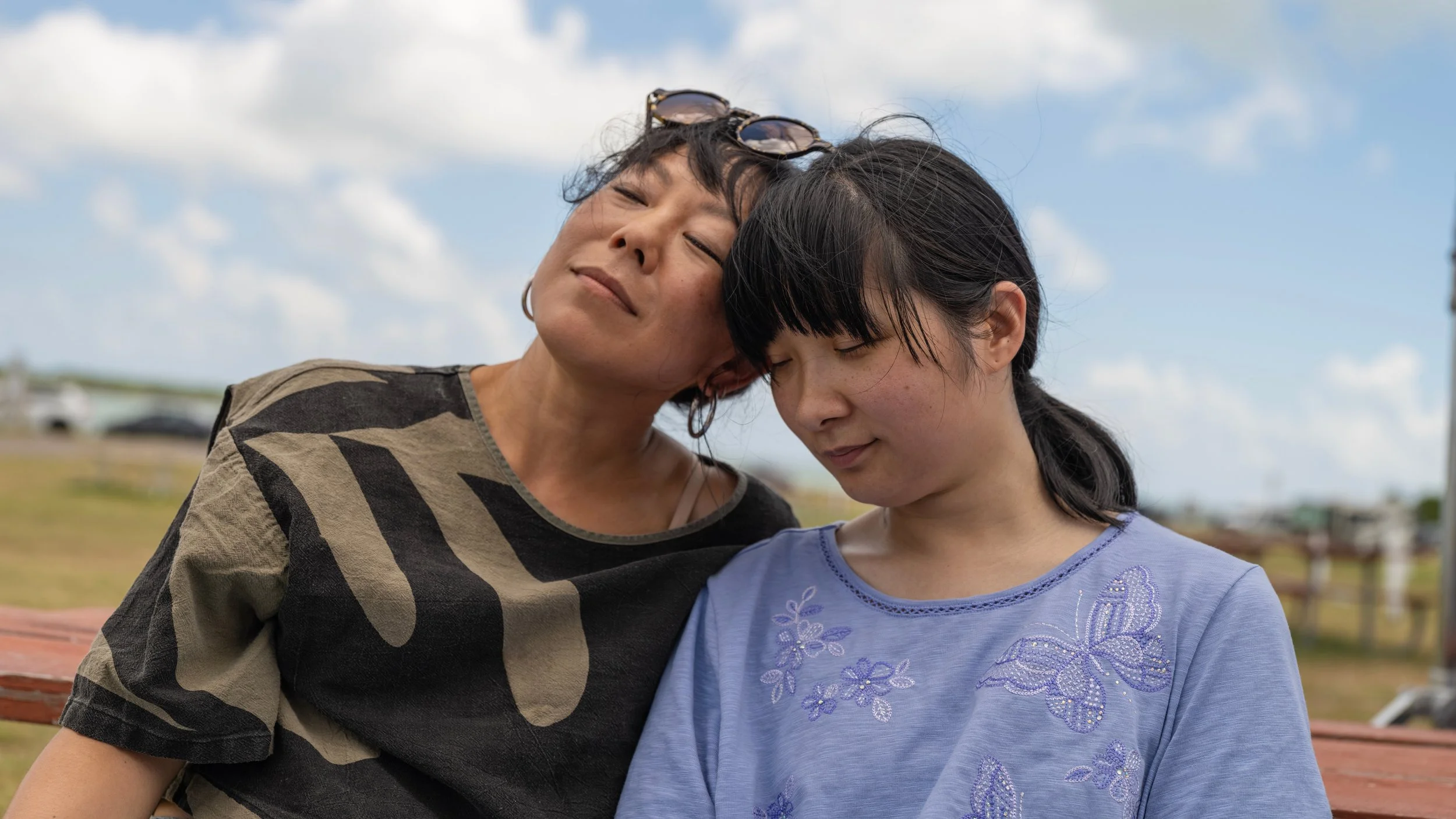
From left, Ali Ahn as Emily and Anna Sargent as Anna in Take Me Home
Photo courtesy of Liz Sargent / Farhad Ahmed Dehlvi
Anna’s performance anchors the film. What was it like, working with your real sister on a story like this?
Part of making this film was a way to multitask and to save my family, to help my parents transition into their next phase of life, and for Anna to grow independence. Through the process, she grew such agency; she really became such a boss and felt so grounded in herself.
It was hard because she’s my sister, and you know, she likes to talk smack to me, and I like to tease her, so it’s not always the best dynamic. People always ask me how I separate my director hat from my sister hat, and I don’t. I don’t know if it’s the right or the most healthy way, but I go into it with such love for her. And my love for her also tells me when I can push her, and also when I need to step back.
Korean identity isn’t necessarily explicitly discussed on screen, but how did you think about representing this part of Anna’s identity alongside all of the other facets of who she is — as a sister, a daughter, a caregiver and a woman with a cognitive disability?
I mean, I add in specifically Korean adoptees because in the ’80s there were almost 200,000 Koreans adopted to the United States, so it’s a very specific identity and community. I feel like there’s a very specific and nuanced experience within that. Because I wrote this in such a personal manner for both Anna and for me, I feel like it’s baked into the film in ways that are so subtle.
We shot in my parents’ house, and to feel that white Midwestern Americana, that’s also (centered around retirees) in Florida, is so specific. And then to see these Asian bodies — this sister who moved to New York and found her own identity outside of that and never really connected to that white Midwestern American identity (versus) Anna, trapped within it. And to me, that’s sort of the adoptee family.
These people are the most different people I can imagine in a space. And they all love each other so much, and I think there’s so much conflict because of who they are, because of their nature, and their ways of communication.
[Editor’s note: South Korean government data counts about 169,000 children adopted overseas between 1953 and 2021, most of them to the United States; estimates that include undocumented adoptions reach 200,000. Adoptions peaked in the 1980s, with about 66,500 that decade.]
There’s a scene where Emily is talking to her father about adoption. She says, “Why did you adopt? Why would you adopt someone with a disability?” It’s a pretty brief conversation, but it carries a lot of weight. What did you want that conversation to reveal about how Emily understands her own adoption and her relationship with her family?
I think a lot of adoptive families don’t talk about adoption in their daily life (and) maybe that’s different than what we see in films. I wanted to create this family that stands on their own and isn’t wrapped around this adoptee trauma or the search for a birth parent. The love is real between all of them.
That scene came out of (my experience) when I was trying to make the documentary in 2015. People used to tell me, “You have to ask your parents why they would adopt so many kids,” in this tone of blame. I asked my father about it... and he snapped at me in that same way, because he could feel that he was being accused of his situation. And why do we have to put that blame on him for adopting someone with a disability, and (for) living a really hard life? That is not his fault; that is this country’s fault. That is the reality.
Oh, I’m getting emotional. It’s just an interesting thing, and I think there’s also sometimes not a clear answer to why people do that. And I wanted us to have to sit with that. I think not having answers is actually very clearly an adoptee experience.
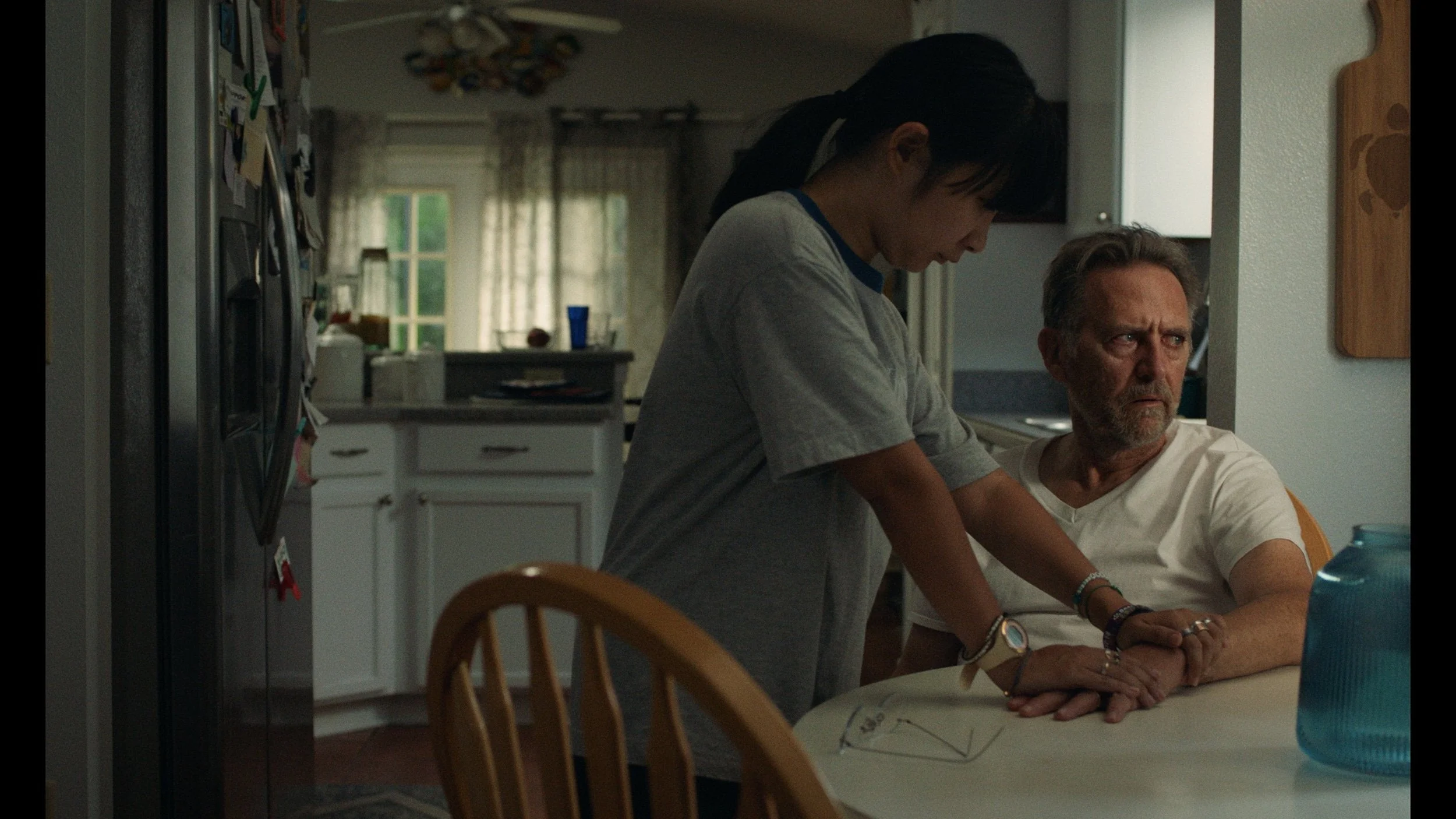
From left, Anna Sargent as Anna and Victor Slezak as Dad in Take Me Home
Photo courtesy of Liz Sargent / Farhad Ahmed Dehlvi
You’ve said there’s a bit more representation for people with physical disabilities, but not so much when it comes to cognitive disabilities. How are you hoping to push the way it’s presented on screen with Take Me Home?
The experiment for this film was: How can we create a bespoke, accessible space for (Anna), so that she can give a great performance? And we would all shift around that and show that it was worth that work. It’s additive to the process.
For disability representation, I hope that they can see a deeper nuance to her as a human, and I think that that’s been hard to see in mainstream work because we make things so fast. We actually just need to offer a little bit more patience in the process and on screen. Like I really tried not to edit her so that the pacing of her language and the way it comes out is her own, and that we, the audience, need to lean in and listen and understand her way of communicating. And to me, if we did that for everyone, it would be a huge shift.
Ultimately, your film explores a lot of different topics: the complicated dynamics between sisters, adoption, health care and family. What do you hope audiences will take away from Take Me Home?
I hope that people sit with the film and ponder it. I’ve always said that, if people are a bit confused at the end, and then 24 hours later something just sort of settles in them, that’s my goal. I love a movie that lingers and doesn’t give you answers.
So that’s what I wanted to offer: for people to be curious about what could exist in this world. And I wanted to show them a world that’s totally possible to create, where Anna and everybody can thrive; it would be better for all communities. So, I hope that people feel hope and feel action to shift the way they move in this world. And I feel like that happens because they fall in love with Anna so much and really understand her.
End of Interview
Take Me Home premiered in U.S. Dramatic Competition at the 2026 Sundance Film Festival, where Sargent took home the Waldo Salt Screenwriting Award. It went on to its international premiere at the Berlinale and its New York premiere at Tribeca. The film made its Canadian premiere at the Vancouver International Film Festival.
Hayley Lee Palmer is a Vancouver-based writer and communications professional working in sports and entertainment. She spends her free time sitting around with friends, rereading the same books and playing ice hockey. You can find her on Instagram.
JoySauce is a multimedia network dedicated to celebrating the full spectrum of Asian American and Pacific Islander narratives. The site boasts a vibrant library of content around entertainment, lifestyle, food, travel, culture, relationships, art, and education in the form of exciting new streaming shows, movies, standup comedy, provocative podcasts, and a suite of editorial updated daily.