
Riley Noland Mixes It Up as an Assertive Christine in the Immersive Masquerade
Mixed Asian Media - October 8, 2026
By Alex Chester-Iwata
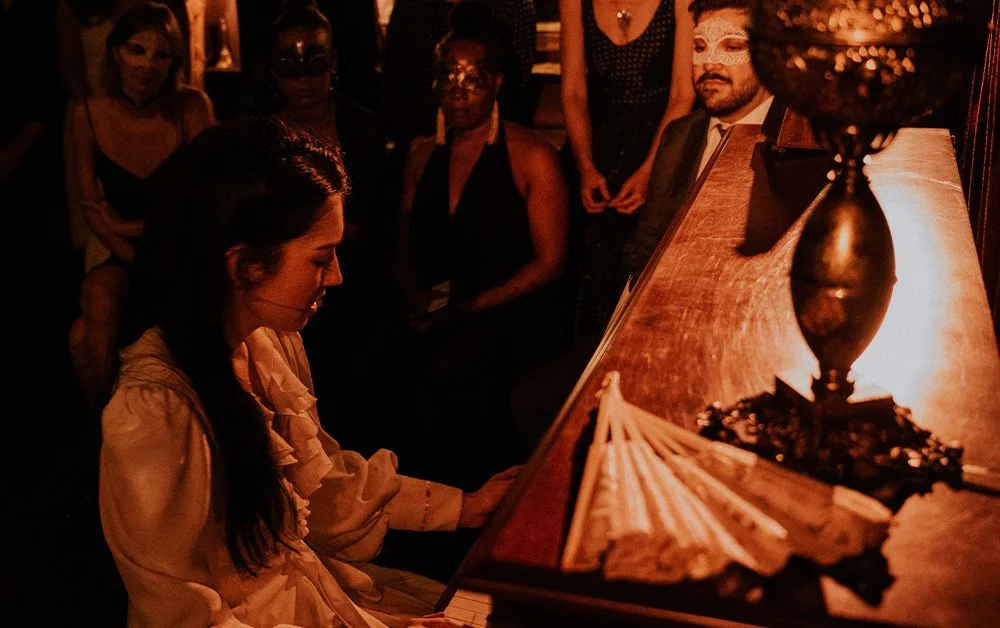
Riley Noland in Masquerade. Photo Credit Andy Henderson
This article is for my theatre nerds. If you don’t know The Phantom of the Opera, maybe scroll past or Google it,then come back and read this awesome interview.
Cool, now that that's taken care of, where are my theatre kids? Do you live in NYC? Have you been obsessed with Andrew Llyod Webber’s Phantom of the Opera since you were a wee theatre bébé? Have you seen the immersive theatrical production called Masquerade?
If you’ve answered yes, then we can geek out together.
For those of you not in the know, Masquerade is an immersive production of The Phantom of the Opera, which takes place in NYC, right across the street from Nordstrom on 57th street. Dubbed “‘the world’s first immersive musical”’ (that can debated), Masquerade has six different casts that rotate throughout the night. I’m not going to get into too many details, as this is something you really need to experience for yourself. But know this, if you love theatre, fantastic storytelling, and you used to be a lil’ goth mixie like me (jk, goth for life,) then this show is for you.
Today, dear theatre geeks, you’re in for a real treat. I had the pleasure of seeing the 8 PM showing with Riley Noland as Christine Daaé, followed by an interview with the Opera Populaire’s newest star.
Noland’s performance is absolutely stunning. Her voice is effortless, and for the first time, I found myself really invested in the overall arc of Christine. She had agency, she wasn’t just a poor, little damsel in distress. She felt like a fully fledged character who had a say in her life. We love a girlie who isn’t a victim.

Anna Zavelson and Georgia Mendes in Masquerade. Photo Credit Andy Henderson
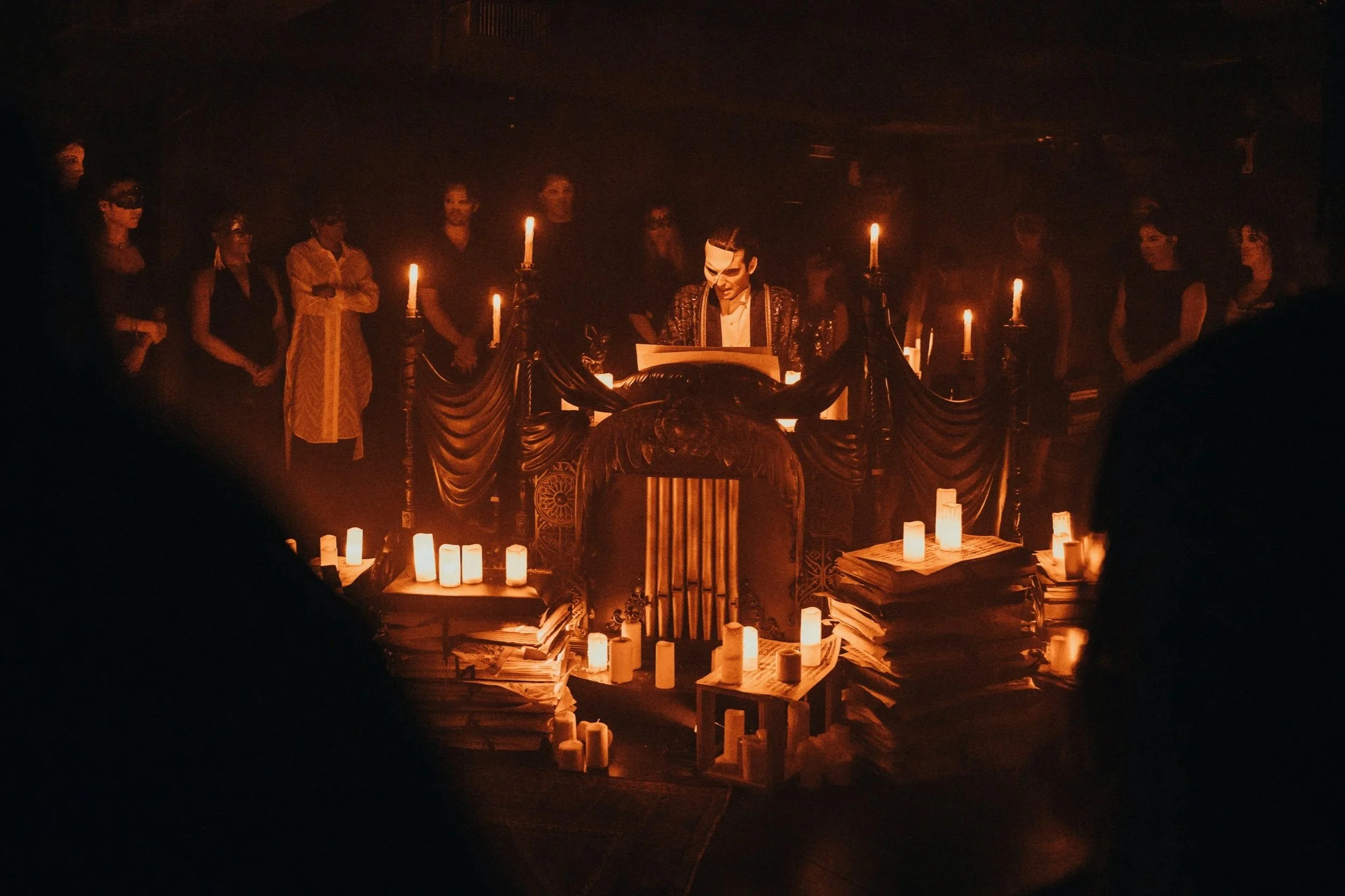
Photo Credit Andy Henderson
Interview
I always love to start with this question: what’s your mix?
I am Japanese and miscellaneous white ethnicities! Mostly Scottish and English.
Christine is a role generations of actresses have stepped into. What did you personally want to bring to her that you hadn't seen done before?
As sacrilegious as it is to admit, I really was quite unfamiliar with The Phantom of the Opera before being cast in Masquerade. It’s intimidating to take on a role as iconic as Christine, and I felt the weight of what this character and material meant to people. For me, it was important that, as I built my Christine, I used my unfamiliarity with the material to my advantage, so that she felt deeply personal and real to me. I didn’t want to fall into the trap of playing an iconic role — playing the character rather than the person.
Without revealing too much, my main sources of inspiration, which I still reference daily, are David Lynch, Nosferatu, and Lana Del Rey.
You grew up in Mānoa Valley in Hawai'i, in a place where mixed and multiethnic identity is often the norm rather than the exception. How did growing up there shape the way you think about your own identity now that you're in casting rooms and rehearsal rooms, where that's not always the default?
I love this question! It’s such a privilege, and I feel so grateful to have been brought up in Hawai‘i. Like you said, being mixed was the norm, so I rarely felt like an outlier. I’ve always felt proud of my mixed heritage and was never made to feel less than because of it.
When I moved to the mainland and inevitably experienced racism in a real way for the first time, my gut reaction was surprise. I’m really fortunate in that way. It cuts less deep because it’s easier for me to say, “Yikes! That’s racist and a you problem,” and let it roll off me, thanks to the nature of my upbringing.
Has being mixed ever shaped how a role was written for you, cast, or directed — for better or worse? Are there moments you can point to where you felt your background was actually seen and used, versus flattened or ignored?
I imagine my race is factored into everything I’ve been cast in, whether those making the decisions were cognizant of it or not. At the risk of sounding trite, I do believe that casting any person of color in roles that have historically been white is a way of our backgrounds being seen and used, because representation is that important.
When you're not performing in a piece that's explicitly "about" identity, does your mixed heritage still show up in how you build a character? Or is there a deliberate separation?
I do feel it’s something I bring into every character, but it’s not necessarily something I’m deliberate about. Every character I play is always going to have the immutable aspects of me, and my identity is a huge part of that.
When I play Christine, I use an acting technique called substitution to connect with the story emotionally, and a lot of that relates to my family. My siblings, my parents, my grandparents, and everyone who came before me are all a part of the thread that weaves together the fabric of my Christine.
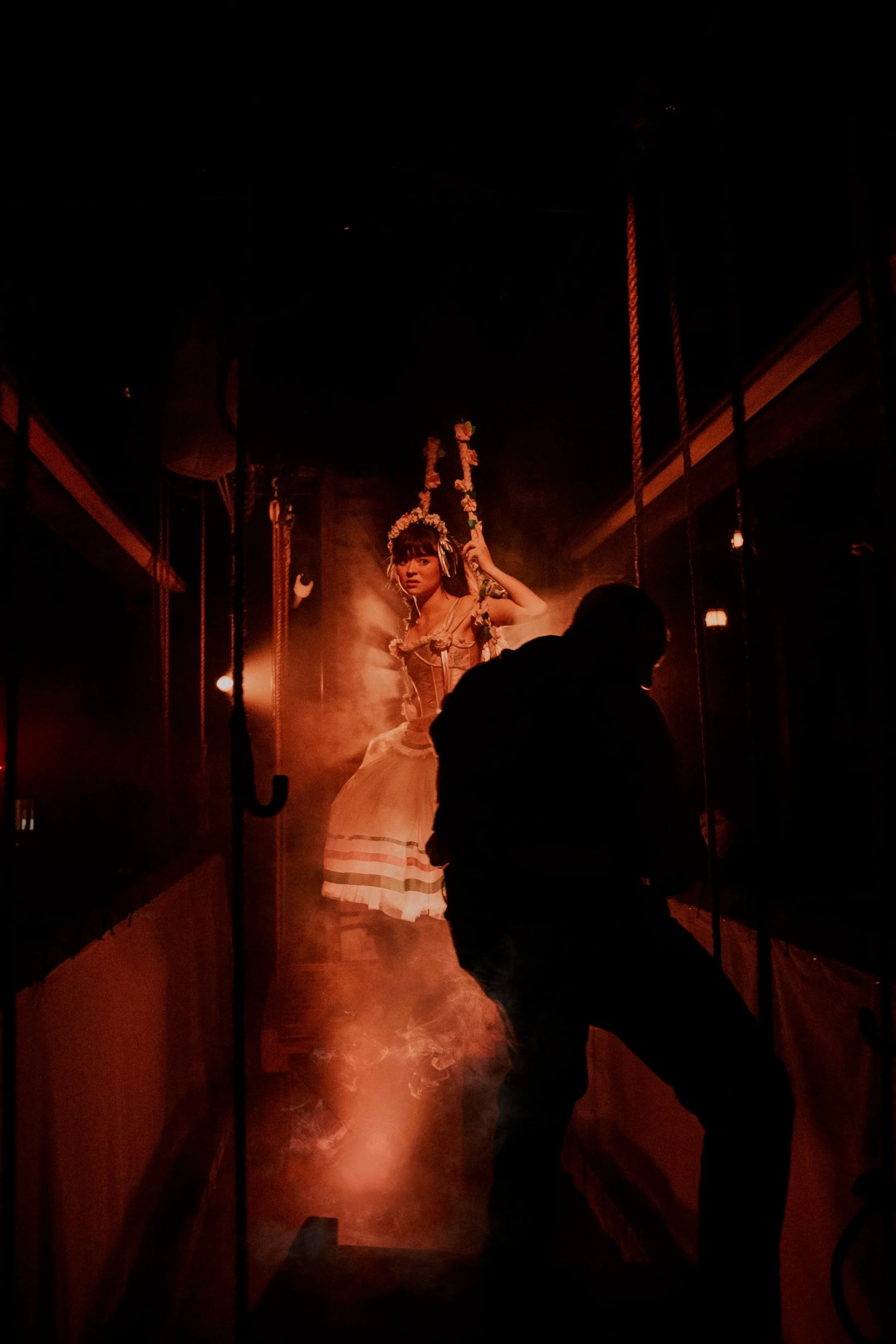
Masquerade Production Photo. Photo Credit Andy Henderson
What's a piece of advice, or a warning, you'd give a young mixed actor who's looking at a career like yours and wondering if there's room for them in it?
Be brave, be authentic, be kind. There’s always room. Anyone who tells you otherwise isn’t worth your time.
I would love to talk about the Japanese side of your family, where they're from, and how that heritage was passed down to you.
My family immigrated from Japan between 1890 and 1905, making me the fifth generation to live in Hawai‘i. Therefore, my cultural upbringing is very specific to the diaspora of Asian Americans in Hawai‘i. We have our own language, our own traditions, and even foods that are unique to us! The culture is an incredible blend of Chinese, Japanese, Korean, Filipino, Portuguese, and Puerto Rican cultures, dating back to the late 18th century — when large waves of laborers immigrated to Hawai‘i to work on plantations.
Does your family carry any history connected to Japanese American incarceration during World War II? If so, how has it shaped how you think about your own identity or the work you choose to do?
Neither of my grandparents’ families were incarcerated during World War II. Both of my grandparents came from poverty and had fathers who weren’t really in the picture, so incarceration wasn’t an issue. My grandpa does have memories of Pearl Harbor and what Hawai‘i was like before it was a state. I love talking to him about old Hawai‘i and what it was like growing up on the island. The stories he has are incredible.
Christine is often played as fragile or purely reactive — someone things happen to. As much as I love this show, I’ve often wanted to scream at her, “Stop letting everyone gaslight you.” You were the first person I have seen play her with real backbone. Was that a deliberate choice, and where did it come from?
Our brilliant director, Diane Paulus, was extremely intentional about making sure Christine had agency in this production. She was very emphatic during the rehearsal process that Christine was exactly where she wanted to be. Christine isn’t a victim or a hostage; rather, she’s fascinated and enthralled by the darkness. That resonated with me deeply and informed a lot of my character.
I’m also a fire sign, if that means anything to you.
Walk us through how Masquerade works. Multiple overlapping shows are happening simultaneously, with six Phantom-Christine pairs performing across the building every night. What's the actual day-to-day rhythm like for you? How many performances do you do in an evening, and how much turnaround do you get between them?
Technically, I’m in three different shows over the course of what I consider to be my one show of the evening. I start my evening as Meg Giry, Christine’s best friend, in the fourth show out of the six. Then I change costumes and join the fifth show as Christine. About halfway through the show, during what I consider my “intermission,” I change back to being Meg in the fourth show. After I’m done being Meg, I change back to Christine and complete the rest of the fifth show as Christine. Once the fifth show has ended, I join the sixth show for their finale as an ensemble member.
If you’re confused by everything I just said, don’t worry, it’s because it’s all extremely confusing. Sometimes I forget which character I am and have to catch myself before I confuse any audience members or change the plot in an irrevocable way.
Despite the insanity of it all, getting to be Meg to a Christine and getting to have a Meg who is also a Christine in the shows before and after mine, is one of my favorite things about Masquerade. I get to spend time with my sisters, giggle with them, and be of service to them.
What has it been like performing in an immersive piece? Have you had to make any changes in how you approach the show?
From the beginning, Diane told us to think “filmic” rather than the typical, larger theatrical acting that’s necessary for traditional proscenium theaters. Because of how physically close we actors are to the audience, we have the luxury of simply having “to be” rather than having “to show.” I love it because it forces me to be present and allows for a communion with the audience that can only be described as magic.
Do you think a more assertive Christine changes the meaning of the story itself — who has power in the triangle with the Phantom and Raoul? Or, is it more about how she carries herself within the same story?
I think there are certain story points that are always going to be a part of Phantom, regardless of interpretation. I think Phantom will always be about mercy and compassion, and about what it means to really see someone no one else sees. What it means to be touched by love. I think it’s about the fact that most of our desires, if not all, are transgressive, whether we are willing to admit that to ourselves or not.
The incredible thing about something as iconic and oft-told as Phantom is that all of us who have been a part of the storytelling have had the same material. What we do with that material is simply a matter of how we color it in. I think a more assertive Christine changes the color, but not the integrity of the picture.
That’s what’s really cool about Masquerade. Every Christine has their own color, every Phantom has their own, and so on and so forth — making every unique combination of casting result in a completely unique and original shade.

Production Photo from Masquerade. Photo Credit Matthew Murphy and Evan Zimmerman for MurphyMade

Production Photo from Masquerade. Photo Credit Matthew Murphy and Evan Zimmerman for MurphyMade
End of Interview
For tickets to Masquerade, you can visit their website at masqueradenyc.com.
Alex (she/her) is an Actor and the Co-Founder/CEO of Mixed Asian Media. Alex received the 2023 Women of Distinction of Assembly 69th of California award and last year was one of the Asian Hustle Network’s top 50 Unsung Heros. Some acting credits include: Broadway’s How the Grinch Stole Christmas, Gillian in This Space Between Us Off Broadway’s Keen Company. TV credits include: New Amsterdam, The Good Fight, and The Closer. Alex is a board member of ACE Next Gen's NYC Chapter and of Strong Asian Lead. She is a community leader for the Lunar Collective and she is also part of the 2023 Jews of Color cohort The Workshop, she also also serves on the advisory board of her alma mater St. Mary's LEAP Program and is a member of Gold House.