Photo credit: Ryan Quan / Joysauce
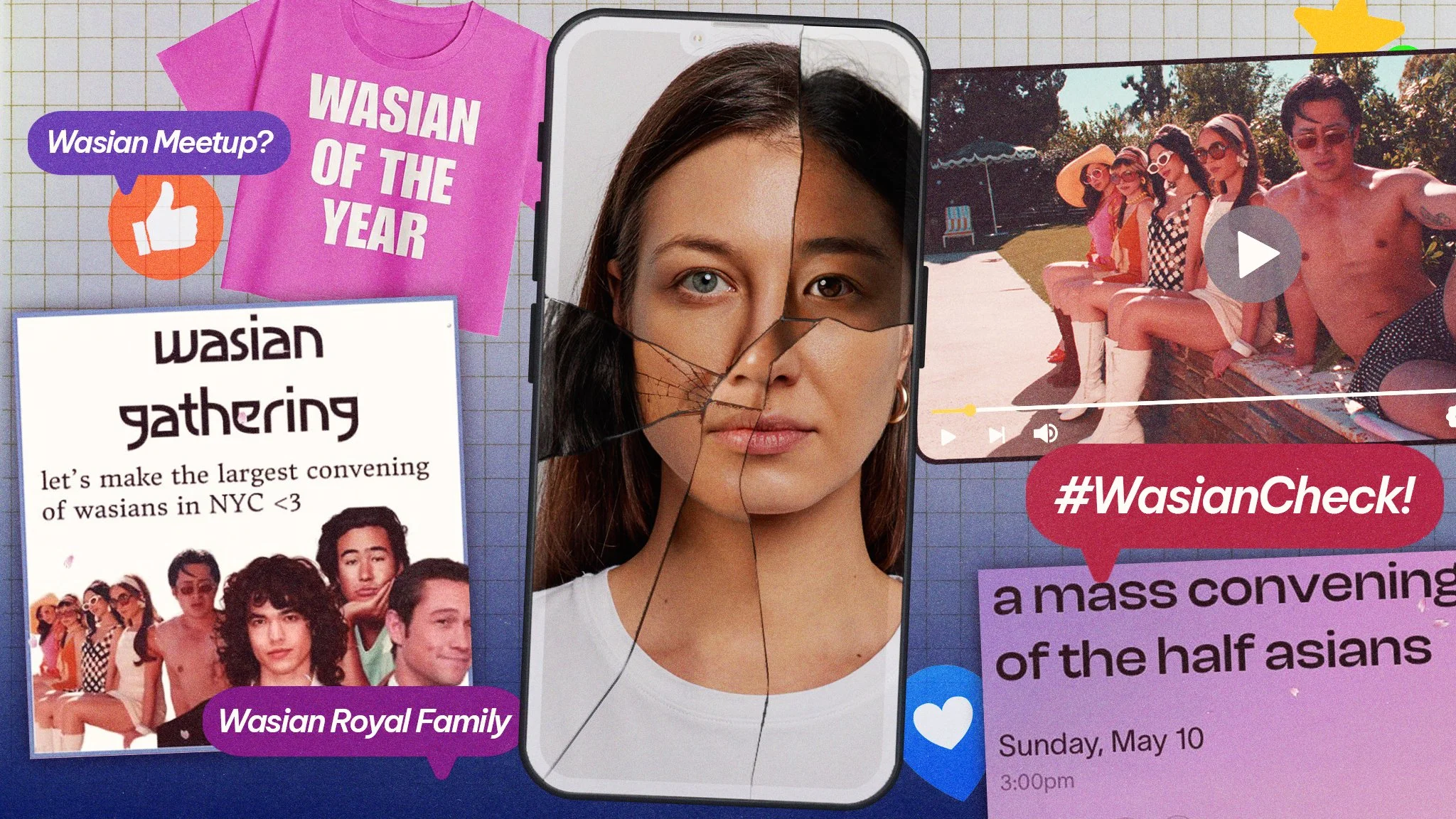
I was walking into my old coffee shop to catch up on some work when I got the text. "So," it started, "everyone keeps sending me this." Attached was a screenshot of an Instagram post by Mochi Mag showing five celebrities — I recognized Alysa Liu first, then Hudson Williams — with a screenshot of a Threads post: "laufey gathering the wasian royal family for her music video is insane. what do you mean alysa liu, lola tung, megan from katseye, and now hudson williams 😧" The initial Threads post, I noticed, had more than 7,000 likes. The Mochi Mag post garnered almost 10,000 more.
Before her minute-long voice note even appeared in Messages, I knew exactly why my friend sent it to me. It had nothing to do with Laufey and everything to do with the word "Wasian," the increasingly mainstream moniker for mixed white and Asian people. Still, curious, I hit play as I sat at my usual table. "I feel like it really isolates the rest of the mixed Asian community," my friend said at one point, before ending it, "What are your thoughts?"
I'd say I cringed as I scanned the image, but the more truthful description involves a multidimensional scatter plot — variables of dread, antipathy and repugnance, with me plotted as a point somewhere among them.
My friend, the co-founder of Mixed Asian Media, wanted to make a statement. Though we both find the term Wasian cringe, she had been tracking the growing discourse. I had admittedly been ignoring it. But faced with a direct question, particularly as the publication's editor-in-chief, I was finally forced to articulate my thoughts.
#WasianCheck
It's not that I don't like thinking about words or systems. Unfortunately, I'm a writer. But Wasian has always felt social-media-coded to me. Performative. Maybe even generational. At first, I only encountered the word online. Sort of like a jump scare. The term in its current use (not its 2000s Urban Dictionary-defined, weeaboo-adjacent origins) came out of a late 2019 TikTok trend called #WasianCheck — a face reveal in which the creator covers their face with their hands, says, "Wasian check," and then drops their hands to reveal their features. The original #WasianCheck video, by Niko Katsuyoshi, gained more than 140,000 likes. By November 2021, nearly 10,000 TikToks had used his sound. By 2022, before TikTok stopped showing view counts for hashtags, the Wasian hashtag had surpassed 1.7 billion views.
Since then, it's started to move offline — into in-person meetups in New York City and San Francisco, major media coverage and the broader vocabulary of mixed Asian identity. The whole thing has always given me "pick me" vibes. It reminds me of a guy my friend matched with on Hinge. "His profile says if I can guess his mix, the first round is on him," she said, handing me her phone. I rolled my eyes. He must have a lot of time on his hands. "I don't know," I shrugged, reaching for the obvious answer. "Probably East Asian and white."
Frankly, I find the whole "guess my mix" game pedestrian. I've been on the receiving end of it from those who think they're slick. You're not going to guess, I tell them. It's not a challenge. Let me put us both out of our misery. No, I'm not Latina. Yes, I'm sure. No, not even a little bit. No one has ever guessed "Greek and Korean." This game only flies because of novelty — I've never cared to guess if someone's Scottish or German, or descended from the Mayflower. It'd be blatantly odd for a monoracial person to pull this stunt. Some do anyway.
"Hm, I'm thinking," I wrote back to my friend as I quickly set up my laptop and opened Chrome, along with my Notes app. Over the next hour, I texted her multiple paragraphs, beginning with the disclaimer, "These are SUPER MESSY notes off the top of my head."
I started off reluctantly defending the term. People want legibility and community. The TikTok growth speaks to that. I even considered the takes I've seen on Instagram Reels or TikTok, which I found to be weak. Many criticize Wasian for centering whiteness by putting the "W" from "white" before "Asian." That's just how portmanteaus work phonetically. (What's the alternative? "Asianite"?) If portmanteau ordering reveals a racial hierarchy, then by the same logic, Blasian centers Blackness, Latinasian centers Latinidad and Mexipino centers Mexicanidad over Asianness. I haven't seen that argument.
But as I kept thinking (thanks, Laufey), my discomfort moved somewhere deeper — beyond the word itself and into the structures underneath it. Namely, what does the rise of Wasian reveal about language, racial history, beauty standards and mixed identity?
The racial elevator pitch
As I browsed the internet for answers, I quickly came across the concept of the "racial elevator speech." The TL;DR is that mixed-race people often develop a simplified answer to the question, "What are you?" that isn't so much about expressing their identity as it is about satisfying the person asking the question. In this case, Wasian is TikTok's crowdsourced elevator pitch.
Okay, I get that.
The number of times the mixed people I know and I have been asked, "What are you?" by strangers is staggering. The best is when you tell them and they ask, "Are you sure?" (I once had a Mexican Uber driver in Los Angeles, where I'm usually perceived as Mexican, argue that Victoria is a Hispanic name; therefore, I must be Mexican.) Anyway, my answer is short and sweet: I'm Greek and Korean.
In fact, whatever I'm assumed to be depends on the local demographic.
Growing up in New Jersey, I was often thought to be Vietnamese or Filipino. In Los Angeles, people pretty unanimously perceived me to be Mexican. In Mexico, locals asked if I was Hawaiian. In Hawaii, locals clocked me as mixed. When I spent months in Thailand, people often assumed I was Thai until I opened my mouth. In Vietnam, people asked if I was Vietnamese (no), then half-Vietnamese (no), then finally settled on some sort of Asian (yes). Ironically, Koreans almost never think I'm Korean. On my first day of a Korean heritage class at UCLA, the professor told me the course was "for Korean students only" and suggested I take the "non-heritage class" instead.
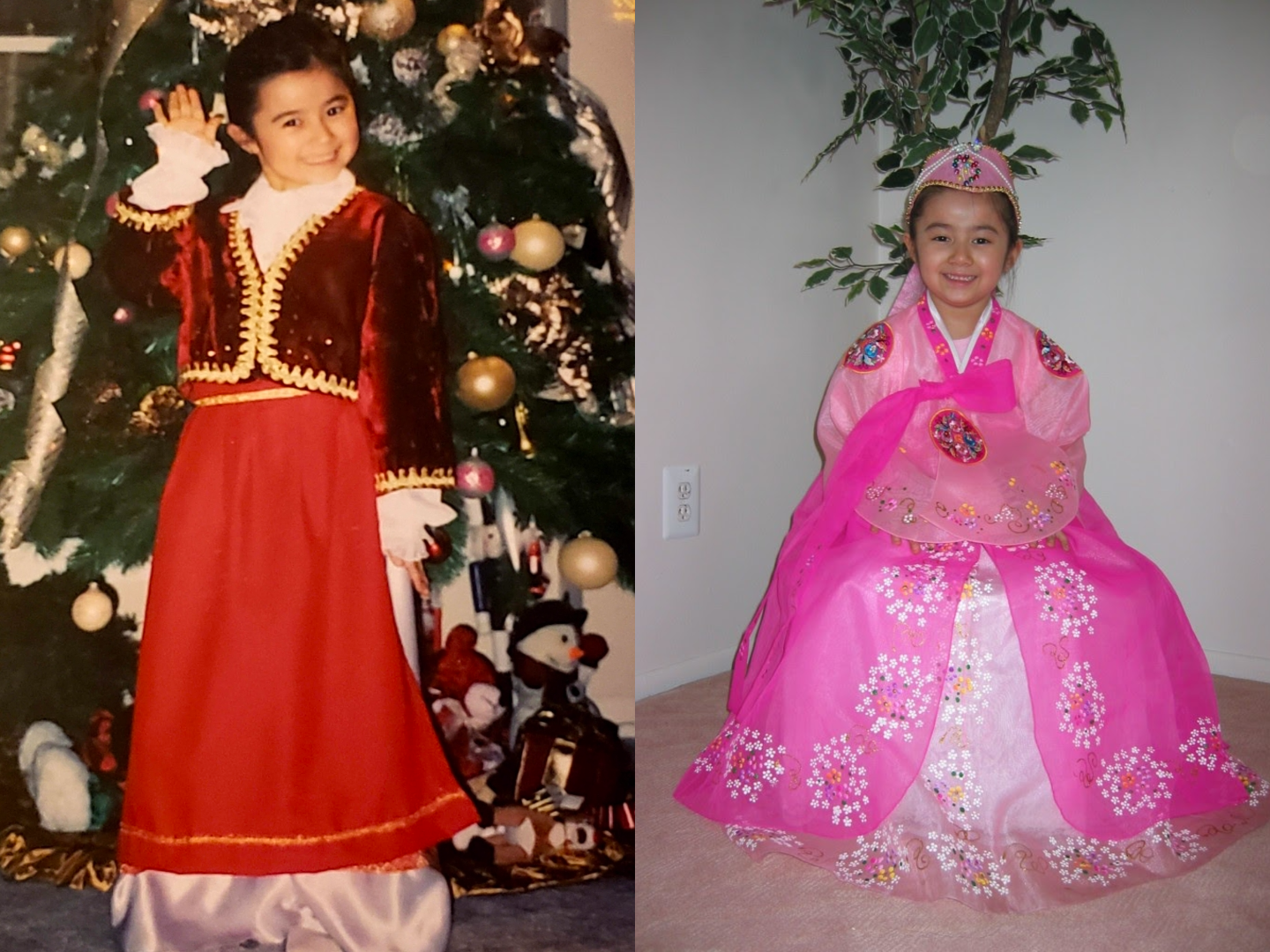
Photo credit: Victoria Vouloumanos
However, I've seen friends pull up a screenshot of their 23andMe results — 50% Chinese, 27% Irish, 13% Italian, 8% Ashkenazi Jewish and 2% Indigenous American (Plains) — to answer. So, in that case, an elevator pitch checks out. It solves a real problem, especially for younger mixed people who want to identify without charting their entire family tree.
I can understand why the term is appealing. Many mixed-race people grow up being othered, so a label like Wasian can feel like a seductive shortcut to recognition. It offers claim, celebration and community in a world that often makes mixed people feel invalidated. But that emotional pull is exactly what makes the term so easy to package. A label that feels like belonging doesn't invite scrutiny of what it excludes — and that packaging has reached a global scale.
When you consider that the Wasian hashtag has well over a billion views on TikTok, it's obvious that this is larger than a niche social media term. According to the 2020 U.S. census, about 2.7 million Americans identify as mixed white and Asian. In other words, the scale of the hashtag far exceeds the U.S. population it describes, revealing that Wasian has become a globally circulating identity term. That's not so surprising when you look at the history of multiracial nomenclature. Societies have always produced terminology for people of mixed ancestry, whether it's geographic, racial or hierarchical.
Half child, hapa and Eurasian
The Thai term luk kreung (ลูกครึ่ง), literally meaning "half child," technically applies to any mixed-race person but is almost exclusively used to describe someone of mixed Thai and Western ancestry. For much of the 20th century, luk kreung were stigmatized. They were often associated with wartime liaisons between Thai women and American GIs during the Vietnam War era. In 1972, a military decree retroactively stripped Thai nationality from people born in Thailand to immigrants without permanent residency, effectively rendering thousands stateless — unable to hold Thai ID cards, own land or access public services. The decree wasn't annulled until 1992.
But by then, culture had shifted. Starting in the mid-1980s, the Thai entertainment industry began favoring the luk kreung look as a growing urban middle class associated Western features — height, prominent noses and fairer skin — with modernity and wealth. Within a generation, luk kreung went from stateless to aspirational, dominating modeling, acting and beauty pageants.
The Native Hawaiian word hapa is a transliteration of the English word "half." While the word originally described any fraction or portion, it became most associated with mixed Native Hawaiian and European ancestry through the term hapa haole (haole originally meaning foreigner, though it now primarily refers to white people). By the mid-20th Century, hapa had traveled to the U.S. mainland, especially California, where it became a popular catch-all for anyone of mixed Asian or Pacific Islander heritage. The expansion was likely enabled in part by the grouping of Asian and Pacific Islander communities under a single API umbrella and the rise of panethnic AAPI organizing, which blurred the lines between Asian and Indigenous Pacific identities. The term even developed its own institutional presence, including hapa organizations and college groups.
In recent years, however, the use of hapa by those without Native Hawaiian ancestry has become increasingly controversial, as critics argue it erases the word's Indigenous roots and the specific Hawaiian history of colonization and blood quantum. Mixed Asian Media itself was originally founded in 2017 as Hapa Mag. In 2021, the magazine rebranded out of respect for the term's Native Hawaiian origins and acknowledgment of the growing criticism that its use by non-Hawaiians erased that history.
The most established term, though, is Eurasian. First recorded around 1820, the term — literally denoting European and Asian parentage — emerged in British colonies like India, Burma, Singapore and Malaysia, where it became an official census category. Unlike luk kreung, Eurasians were often positioned as a buffer class between white colonial rulers and local populations, and frequently employed in clerical and civil service roles.
“While Wasian became a neologism after a TikTok trend, the Eurasian identity has centuries of institutional, communal and geographic grounding.”
Across generations, Eurasian evolved beyond a descriptor of parentage into a set of distinct, place-based identities. Throughout former British, Dutch and Portuguese colonies, communities developed their own social institutions, cuisines and creole languages — each tied to specific colonial histories and ancestral compositions. For instance, the Kristang of Malaysia — referring to both a community and a creole shaped by Portuguese, Malay and Hokkien — are the product of centuries of intermarriage in Malacca.
In countries like Singapore, Eurasian remains a state-recognized ethnic category, with its own associations, political representation and cultural infrastructure. The Eurasian Association, founded in 1919, originally defined the identity patrilineally — centering European paternal lineage in practice — before expanding it in 2012 to include anyone of mixed European and Asian parentage. While Wasian became a neologism after a TikTok trend, the Eurasian identity has centuries of institutional, communal and geographic grounding.
Geography versus race
In this context, the linguistic shift from Eurasian to Wasian in the United States makes sense. I've never met a white American who identifies as European, so subbing out European for white checks out. However, that swap produces a fundamentally different term, and the distinction matters.
Eurasian, a portmanteau of European and Asian, is a toponym. It describes geographic origin: a parent from Europe and a parent from Asia.
By anchoring itself to geography rather than race, Eurasian avoids some of the criticism leveled at Wasian. An Ashkenazi Jewish and Chinese person who doesn't identify as white could still reasonably identify as Eurasian.
Yet the same geographic specificity explains why Wasian has overtaken Eurasian on social media. A mixed white-Thai teenager in Thailand with an American parent might not identify as European. So when the language circulating on global platforms offers white and Asian as the most legible categories, Wasian becomes the intuitive shorthand.
Unlike Eurasian, which produced distinct, localized cultures, Wasian operates with no institutional or geographic anchor. It's broad enough to travel and simple enough to scale, reflecting a digital homogenization in which American racial language displaces older, toponymic terminology.
More than a digital shorthand, then, Wasian functions as a strict racial category. Whereas Eurasian points to origin, Wasian collapses that into race — a social construct historically tied to class, access and power in the United States. And it inherits that collapse directly from its source words: white and Asian.
How people became "white"
Look at the definition of "white" alone from the U.S. Census Bureau's glossary:
A person having origins in any of the original peoples of Europe, the Middle East, or North Africa. It includes people who indicate their race as "White" or report entries such as Irish, German, Italian, Lebanese, Arab, Moroccan, or Caucasian.
Though the census definition looks neat, the history behind it is anything but. Since the Naturalization Act of 1790, whiteness in the United States has functioned as a legal threshold for citizenship, land ownership and voting rights. Historically, that boundary expanded only when admitting new groups strengthened, rather than threatened, the political power attached to whiteness.
Irish immigrants, though never legally barred from whiteness, were socially exiled from it for decades — even caricatured in mid-19th Century cartoons as "simian," the subhuman trope still used against Black Americans. The Irish eventually secured their place within American whiteness in part by aligning themselves against Black communities.
For Southern Italians and Greeks, the barrier was institutional, not just social. As late as 1911, they were classified as an inferior race beneath Anglo-Saxons, and their eventual inclusion in whiteness was a legislative response driven by immigration panic, not acceptance.
The Immigration Act of 1924 made that explicit. Congress based immigration quotas on the 1890 census, which predated major waves of Southern and Eastern European immigration, effectively codifying Anglo-Saxon dominance. As historian Mae Ngai argues, the law ranked European nationalities by desirability while uniting them into a "white American race" set against everyone deemed non-white. Italians, Greeks and Slavs received smaller quotas than the British and Germans, but they were still classified as white, and that classification proved durable in ways the national-origin hierarchy did not. Finer categories like Mediterranean and Slavic would have splintered the emerging white coalition. Folding all Europeans into whiteness instead built a racial majority large enough to dominate American politics and institutions for decades.
Meanwhile, Middle Eastern and North African immigrants had to litigate their whiteness in court. In 1909, Lebanese immigrant George Shishim was denied citizenship on the ground that he was "Mongolian." He sued, and rather than argue the science of race, he challenged its cultural and religious logic: "If I am a Mongolian, then so was Jesus, because we came from the same land." The judge agreed.
In every case, whiteness expanded not out of benevolence but because expansion preserved its power — often by drawing lines against Blackness, Asianness or non-Christianity. Though the census category grew broad enough to encompass Irish, Italians, Lebanese and Germans, its cultural center remained Anglo-Saxon and Protestant. Even now, when Americans hear "white," they typically picture a WASP: white, Anglo-Saxon, Protestant. It's why when I tell people I'm half white before specifying that I'm Greek, they often make a face and then joke that it's a "spicy white."
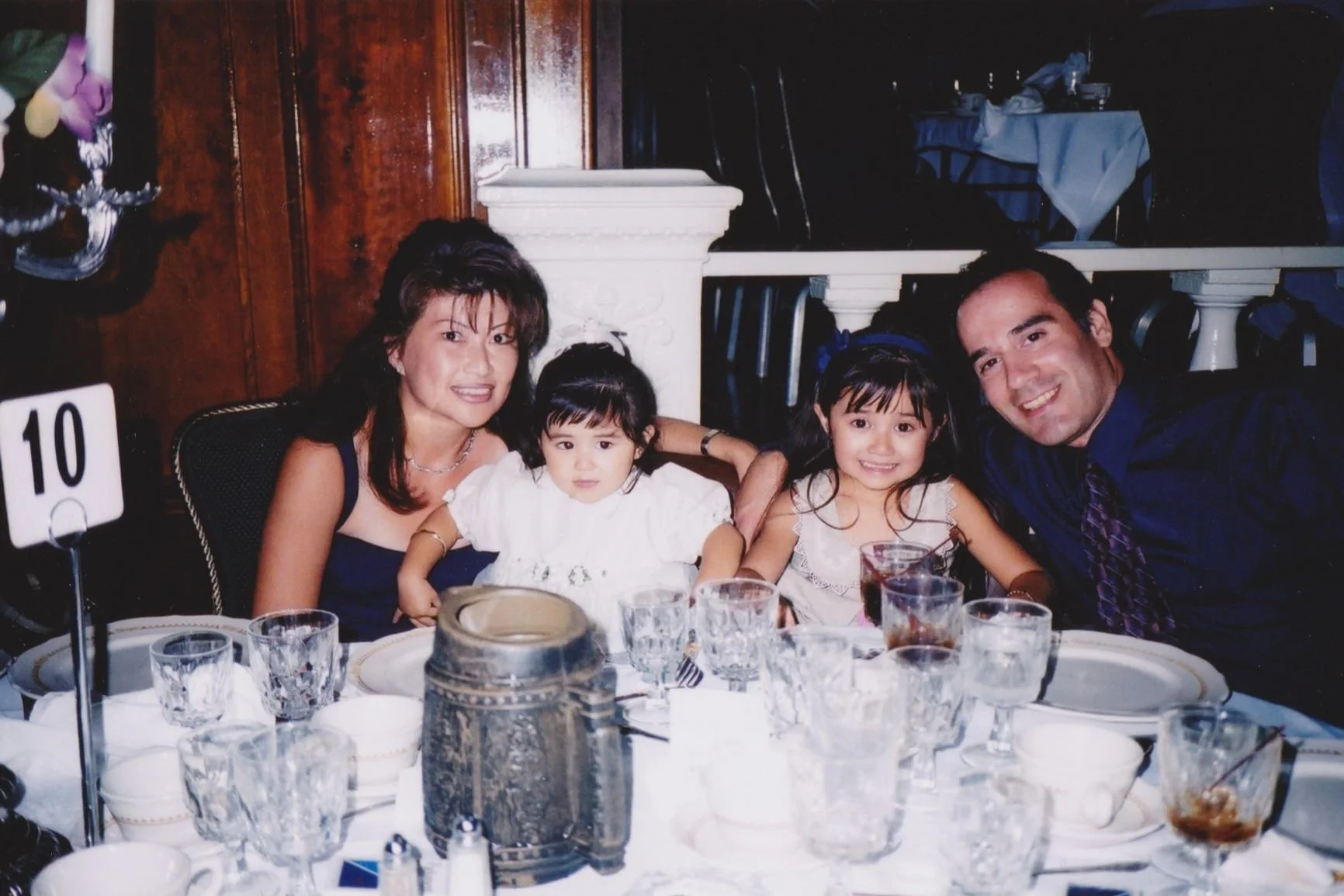
Photo credit: Victoria Vouloumanos
The making of "Asian American"
A parallel compression happened with the term Asian. The Immigration and Nationality Act of 1965 finally dismantled the 1924 quota system that effectively barred Asian immigration for 40 years, triggering a massive demographic shift. In 1968, the term "Asian American" was coined at UC Berkeley by graduate students Yuji Ichioka and Emma Gee. Before this, Asian people identified by heritage — such as Japanese or Chinese — or were subjected to the colonial umbrella of "Oriental." Inspired by the Black Power and American Indian movements, Ichioka and Gee formed the Asian American Political Alliance around a shared political struggle against systemic racism, not a shared culture.
In 1982, the murder of Vincent Chin proved the strategy's necessity. Chin, a Chinese American man in Detroit, was beaten to death by two white men who worked in the auto industry and blamed Japan for American job losses. Ethnic distinction was irrelevant. The tragedy made it clear that if Asian people were treated as a monolith, then survival and advancement required organizing as one.
However, the political tool came with a cost that mirrors the compression of whiteness. Flattening an enormous continent into a single category made East Asians the default center of Asian America while obscuring the unique socioeconomic realities of South and Southeast Asians. Even inside that center, the distinctions dissolved. Long before K-pop and K-dramas entered the American mainstream in the 2010s, my first grade classmates would ask if I was "like Ivan" when I told them I was Korean. "No," I'd sigh. "Ivan is Chinese."
Wasian narrows the frame even further. I technically fall under the term, but rarely under the image it conjures. When I was 18, an Asian American floormate stopped me and my roommate in our Los Angeles dorm to ask her, "Oh my God, are you hapa?" My roommate was half Chinese, half WASP. I was there. It's unsurprising, then, that Wasian evokes a specific aesthetic: WASP and East Asian features, not the mixed Polish and Indian kid from Chicago, like actor Danny Pudi.
Who got to choose a name
The fact that a casual, self-chosen term like Wasian could emerge at all is revealing. Not every multiracial combination has had that option. For mixed white and Black Americans, the one-drop rule assigned people to Blackness, regardless of their actual ancestry. The legal doctrine of partus sequitur ventrem — that children inherit their mother's status — meant the children of enslaved women were automatically born into slavery, giving slave owners a direct economic incentive to classify mixed-race children as Black. The doctrine, as historian Jennifer Morgan has shown, transformed Black motherhood from a family relationship into a property relationship: Children weren't just born enslaved but as commodities.
The terms that did emerge — mulatto, quadroon, octoroon — were rooted in slavery-era racial taxonomy, making their reclamation much more complicated. Rapper Latto, for example, originally performed as Miss Mulatto, then Mulatto, before apologizing and shortening her name after backlash over the term’s history.
For mixed Native Americans, the logic inverts. It benefited the federal government to classify as few people as Native as possible because fewer tribal members meant fewer treaty obligations, less land to honor, and lower costs. Consequently, blood quantum became the mechanism. Unlike with Blackness, mixedness didn't absorb people into a category. Rather, it diluted mixed Native Americans' claim to one. Latino and Hispanic Americans complicate the picture even further as the United States doesn’t classify Hispanic as a race at all, meaning the mixed Latino identity technically exists outside this framework.
Structurally, mixed white and Asian people were never subjected to anything equivalent. That gap — combined with the hapa controversy, the 276% increase in multiracial identification between the 2010 and 2020 U.S. censuses (driven by both demographic growth and changes in how the census measured race), and the 2.7 million mixed white and Asian Americans — left space for a casual, self-chosen term. Wasian filled it.
Yet no other mixed-race portmanteau has reached comparable traction. The closest contender is Blasian, which has real currency of its own — a lineage that runs through hip-hop, Tiger Woods-era discourse and decades of Black and Asian American cultural exchange, rather than through a face-reveal trend. But the comparison clarifies more than it complicates.
Part of it is pure scale. Mixed white and Asian people make up roughly two-thirds of all mixed Asian Americans, whereas mixed Black and Asian people account for only about 6% to 7%. The rest is valence. Blasian doesn't trade on proximity to whiteness. Wasian is the only mixed-race shorthand that can — which is why the centering-whiteness critiques I've seen across social media are sensing something real, even if the linguistic argument misses the mark.
From stigma to brand
The deeper discomfort critics feel is that the identity has been commodified. From luk kreung to Wasian, the shift from stigma to aspiration wasn't driven by a progressive acceptance of mixed people as a whole. It was driven by Eurocentrism, global markets and beauty standards rooted in colorism — the preference, both within and across racial communities, for lighter skin, higher and thinner nose bridges, straighter hair, height and generally European-adjacent features. Whether it's comfortable to acknowledge or not, mixed white people are often seen as more "palatable," especially in Western societies, from Zendaya and Amandla Stenberg to Henry Golding and Hudson Williams. Consequently, the explosion of the term Wasian doesn't just reflect the globalization of American racial language — as seen in the displacement of terms like Eurasian — but the globalization of the American colorist hierarchy that comes with it.
Naturally, social media amplifies this. Through the screen, Wasian has evolved beyond a label and become a brand — a form of visual currency. The trend that arguably started it all, #WasianCheck, is nothing but a face reveal. The most legible thing about it is an aesthetic — or, more aptly, a phenotype — not a lived history. It's a sort of trendy, modern eugenics, in which creators hop on TikTok to effectively say, "Look at what my genes did," which would be strange — nationalist at best, supremacist at worst — in any other context. And the disproportion from earlier points one way: a hashtag that dwarfs the population it names works as a mass spectacle, performed for an audience far larger than the group it describes. In other words, Wasian isn't just about making a claim. It's about being watched.
Obviously, this is not to say mixed white and Asian people should feel guilty for being mixed white, or for being read as palatable. That's systemic. But treating that palatability as inherently interesting — as something to showcase rather than unpack — is worth examining. Even proximity to that rhetoric draws backlash. Sydney Sweeney faced criticism for her American Eagle ad in which she said, "Genes are passed down from parents to offspring, often determining traits like hair color, personality, and even eye color. My jeans are blue," before a voiceover stated, "Sydney Sweeney has great jeans."
Social media rewards identity that can be understood instantly and visually. That's a critique of the platform, not the users, but it doesn't absolve them. If a format explicitly rewards users for showcasing their genetic makeup, then those users are making a choice about what they showcase and why. That's why Wasian feels so performative and shallow to many of us. Whether intentionally or ignorantly, the term trades on proximity to whiteness under the guise of an inclusive hashtag. At that point, Wasian isn't describing mixed white and Asian people. It's describing the moment a mixed identity becomes legible enough to become a commodity.
The royal family problem
Which brings me back to Laufey's "Madwoman" music video. It didn't take long for fans to recognize that Laufey and her four castmates "share a similar cultural background," to quote director Warren Fu. While various publications, including The Hollywood Reporter and People, described described them as "Asian and Asian American" or "half-Asian," the internet simply dubbed the lineup "Wasian."
But consider the actual geographic and cultural composition of the cast: Laufey is Chinese and Icelandic and grew up in Reykjavik; Hudson Williams is Dutch, British and Korean and grew up in British Columbia; Alysa Liu is Chinese and white and is from Oakland; Lola Tung is Chinese, Swedish and Eastern European and was raised in New York City; Megan Skiendiel is Chinese Singaporean and Swedish and was born in Honolulu. Yet the "Wasian" umbrella flattened their distinct ancestries into a single, visual data point.
Laufey herself never positioned the video as a Wasian manifesto. She said she wanted representation for people who looked like her. The video's internal world — from the mahjong, to the egg tarts, to the Wong Kar-wai lighting — draws specifically on Chinese and Hong Kong visual language. But the institutional framing told a different story. Gold House, the API nonprofit that coproduced the video, embraced the internet's label, with its general manager of studios, Christine Yi, celebrating the "all-Wasian" cast as "one of those firsts" and "another unique and beautiful facet of the Asian diaspora." That friction is the point. Laufey made a video about her heritage. Gold House and the internet processed it as a demographic product.
To be fair, Hollywood representation has always relied on a certain amount of ethnic and national approximation. Professionally and pragmatically, casting often works through proximity. German characters aren't always played by German actors; Italian characters aren't always played by Italian actors; and Asian characters aren't always played by actors of the same heritage. We accept that aggregate visibility requires broad strokes.
Spend the two syllables
However, Wasian isn't doing what casting does. It isn't an approximation in the service of visibility. The defense of it usually lands in one of two places: convenience or identity.
The convenience argument is simple enough: Wasian is shorter than "white and Asian." But shorter by how much? Two syllables? If language shapes perception — which is the whole reason words and labels matter in the first place — then two syllables are a strange place to suddenly surrender precision. It's not as if Wasian compresses neutral categories. It fuses two terms that are already products of historical compression: whiteness, which absorbed difference to consolidate power, and Asianness, which compressed difference to build political solidarity.
Wasian does neither. It doesn't organize people around a shared struggle or a coherent historical experience. It produces something else: legibility.
So if Wasian is just TikTok's crowdsourced racial elevator pitch, then the pitch is bad. "White and Asian" already says the thing plainly. And if the claim is that Wasian isn't shorthand but identity — community, affiliation, belonging — the problem only gets clearer. Because the criticism from many non-white mixed Asian people is usually not "Where's our version?" but "Why can't we attend yours?" It's the thing my friend named in her voice note — that Wasian isolates the rest of the mixed Asian community — made literal.
That shifts the burden back onto the term. A real affinity space can explain what shared condition its boundaries protect. A Korean adoptee group exists because being a Korean adoptee is a specific lived condition. A Black-and-Asian group can point to the experience of navigating anti-Blackness in Asian spaces, and Asianness in Black ones. Press Wasian the same way and the answer collapses. If people with overlapping experiences of mixed Asian identity can be denied because they don't fit the category visually, the exclusion stops being incidental and becomes a tell.
The question is no longer whether the boundary is fair. It's what the boundary is tracking.
The blunt answer is appearance.
That's what makes the "royal family" jokes and the meetups relevant. The category sorts people in and out by phenotype, and a narrow one at that. Not every white-and-Asian person reads as Wasian — the specific WASP and East Asian look. An identity built around a shared history or politics can explain its borders. A category built around a face can't.
That doesn't mean the loss people feel is imaginary. But it's worth being precise about what was actually lost, because there was never a lack of language or community. "Mixed" has always existed. So has "white and Asian." I've spent my entire life as a Greek and Korean woman without some umbrella portmanteau, and I'm not holding out for "Korgreekan" (big yikes) to feel seen. UCLA has had enough mixed students for a Mixed Student Union since 2010. Though the club was heavily composed of mixed Asians, nobody in my years there used Wasian. We all just identified as mixed. Even Mixed Asian Media, the publication I edit, has been around since 2017 — two years before the hashtag. We've been here.
“So if what Wasian adds isn’t history, politics or a shared condition — just membership in a category organized around legibility — then the category itself is the problem.”
I understand the pull. When you grow up being othered, recognition can feel like relief, and rejecting the term can land like the oldest problem mixed people face: being told there still isn't a word for you. But there was always a word, and there were always rooms to say it in. What Wasian offers is not community itself, but a version of it that can be searched, branded and recognized on sight.
So if what Wasian adds isn't history, politics or a shared condition — just membership in a category organized around legibility — then the category itself is the problem. If mixed people are already flattened for other people's understanding, the answer isn't to make the flattening catchier. It's more language.
After texting me the Mochi Mag repost, my friend ended her voice note with a question: "What are your thoughts?" Though it took me hours of messy notes and research and thousands of words since, the short version fits in a simple text:
Spend the two syllables.

Victoria Vouloumanos is a writer and editor based in New York. Her work explores how identities and narratives are constructed and consumed across culture, media and politics. She is the editor in chief of Mixed Asian Media and a former culture editor at BuzzFeed. Victoria is also the founder of Parallax, a newsletter analyzing geopolitical events through shifting perspectives. She holds an English degree from UCLA, where she also studied physics until she realized she did not want to work in a lab, and approaches storytelling with a systems-first lens. Recently, she spent a year traveling through Asia and Australia, where she trained in Muay Thai in Chiang Mai, drove a boat along the Yarra and bungee-jumped in Macau. Find more of her work at victoriavouloumanos.com.
JoySauce is a multimedia network dedicated to celebrating the full spectrum of Asian American and Pacific Islander narratives. The site boasts a vibrant library of content around entertainment, lifestyle, food, travel, culture, relationships, art, and education in the form of exciting new streaming shows, movies, standup comedy, provocative podcasts, and a suite of editorial updated daily.